
Your cart is empty
Start shopping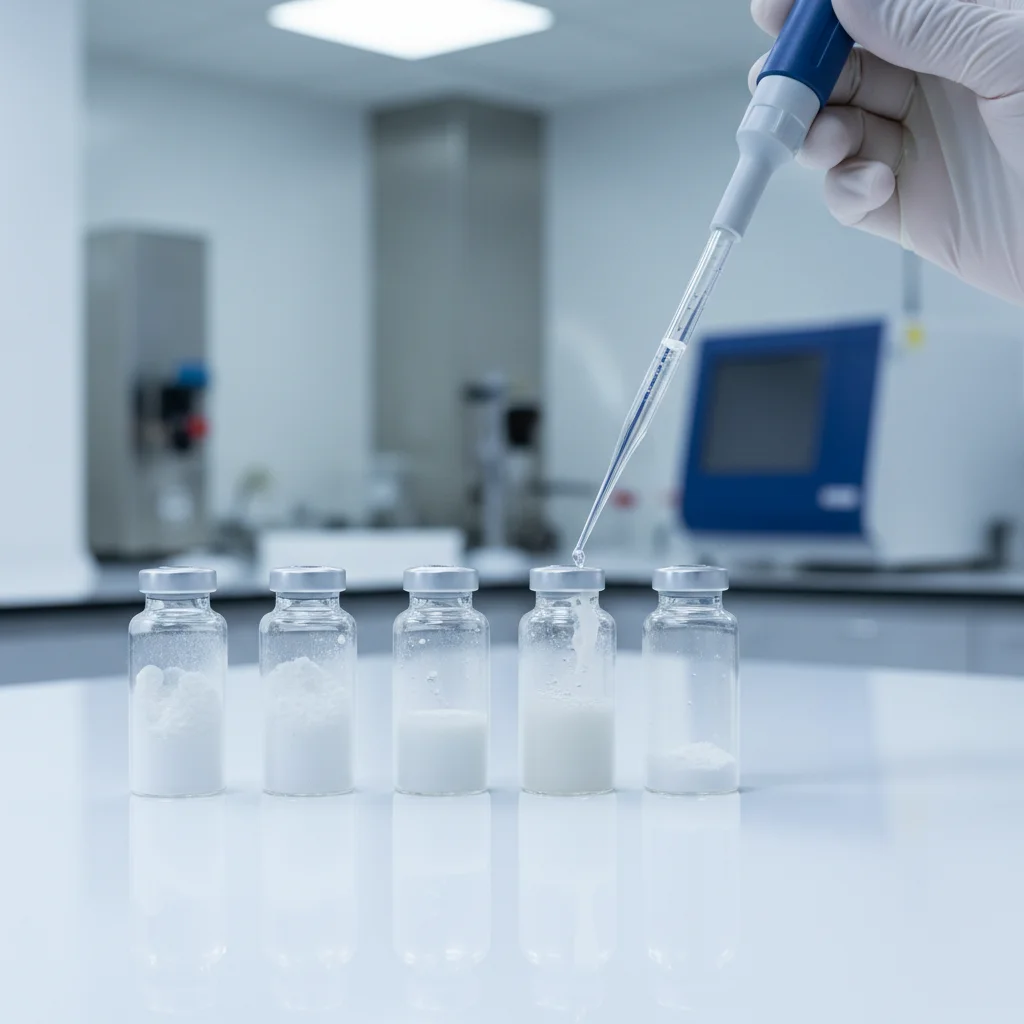
How to store and reconstitute lyophilised peptides for research
Imagine you have received a valuable ingredient that has to be kept in perfect condition until it is needed for an experiment. Lyophilised (freeze-dried) peptides in the laboratory are exactly like that – sensitive to moisture, heat and light. In this article we explain in simple terms how they are stored and how they are prepared (dissolved) before research. All of this applies only to laboratory, in vitro work. If you are looking for the materials themselves, take a look at our catalogue.
Why proper storage matters so much
Peptides are fragile. Even in dry powder form they can be damaged by moisture, high temperature or direct light. If storage is inadequate, the material may change its properties in the laboratory and the research results become unreliable.
In short: good storage helps keep a sample the way it was when it arrived. This matters when you want an experiment to be reproducible and accurate.
Storage rules
Lyophilised peptides are usually kept dry, dark and cold. Here is a simple list that laboratories generally follow:
- Dry vial – freezer. An unopened lyophilised peptide is usually kept in a freezer (about −20 °C or below), where it lasts the longest.
- Short term – refrigerator. If the sample will be used soon, it is sometimes kept in a refrigerator (about +4 °C).
- Darkness. Light can be harmful, so vials are kept in a dark place or a closed box.
- Dry environment. Moisture is the main enemy. The vial is opened only when necessary and closed tightly.
- Clear labelling. The vial is labelled with the substance, the concentration (if already reconstituted) and the date. This helps avoid mix-ups and spot an ageing sample in time.
One more tip: try to take the vial out of the freezer and put it back as rarely as possible. The material does not like frequent temperature fluctuations.
How a peptide is dissolved (reconstitution)
Reconstitution simply means dissolving dry powder in a liquid. It is done slowly and gently, because peptides do not like vigorous shaking. Here is a simple step-by-step procedure:
- 1. Let it warm up. Before opening, leave the cold vial at room temperature so that no condensation (dew) forms.
- 2. Pour down the side. Let the solvent run slowly down the inside wall of the vial rather than directly onto the powder.
- 3. Swirl gently. Swirl the vial lightly in your hand until the powder disperses. Be patient – it sometimes takes a few minutes.
- 4. Do not shake. Vigorous shaking can damage the material and cause foaming. Here, patience matters more than speed.
The solvent is chosen according to the research protocol. One of the most commonly used is bacteriostatic water, which we cover below.
What is bacteriostatic water
Put simply, it is water with a small amount of preservative that inhibits microbial growth. This makes it suitable when a vial is opened and used more than once – it helps keep the solution cleaner for longer than plain water.
Most common mistakes
- Pouring liquid directly onto the powder. It is better to pour it down the side so that the material is not affected too strongly.
- Shaking the vial. Instead – slow swirling in the hand.
- Opening a cold vial straight away. Moisture forms inside. Let it warm up.
- Missing labels. Without the date and concentration it is easy to get confused.
- Opening the freezer often. Temperature swings shorten the usable life of the sample.
By following these simple principles, samples in the laboratory stay in good order and research becomes more reliable.
Important: all peptides and materials discussed in this article are intended solely for laboratory and scientific research (in vitro). They are not intended for human or animal consumption, are not medicines or dietary supplements, and may not be used for diagnosis or treatment.
Frequently asked questions
Why should a cold vial be left at room temperature before opening?
If a cold vial is opened straight away, condensation – dew – forms inside it. Moisture is the main enemy of lyophilised peptides, so the vial is first left to warm up and only then opened. This is one of the most common mistakes when working with dry samples.
What is the difference between storing in a freezer and in a refrigerator?
An unopened lyophilised peptide is usually kept in a freezer at about −20 °C or below, where it lasts the longest. If the sample will be used soon, it is sometimes kept in a refrigerator at about +4 °C. In both cases darkness and a dry environment are important, and frequent temperature fluctuations shorten the usable life of the sample, so it is best to take the vial out and put it back as rarely as possible.
Why should the vial not be shaken during reconstitution?
Vigorous shaking can damage the material and cause foaming, so the vial is only swirled lightly in the hand until the powder disperses. This sometimes takes a few minutes, so patience matters more than speed. For the same reason, the liquid is allowed to run slowly down the inside wall of the vial rather than being poured directly onto the powder.
Does the sample preparation described here mean the material can be consumed?
No. All peptides and materials discussed in this article are intended solely for laboratory and scientific research (in vitro). They are not intended for human or animal consumption, are not medicines or dietary supplements, and may not be used for diagnosis or treatment. The steps described are sample preparation for laboratory work, and no instructions on use or amounts are given.