
Your cart is empty
Start shopping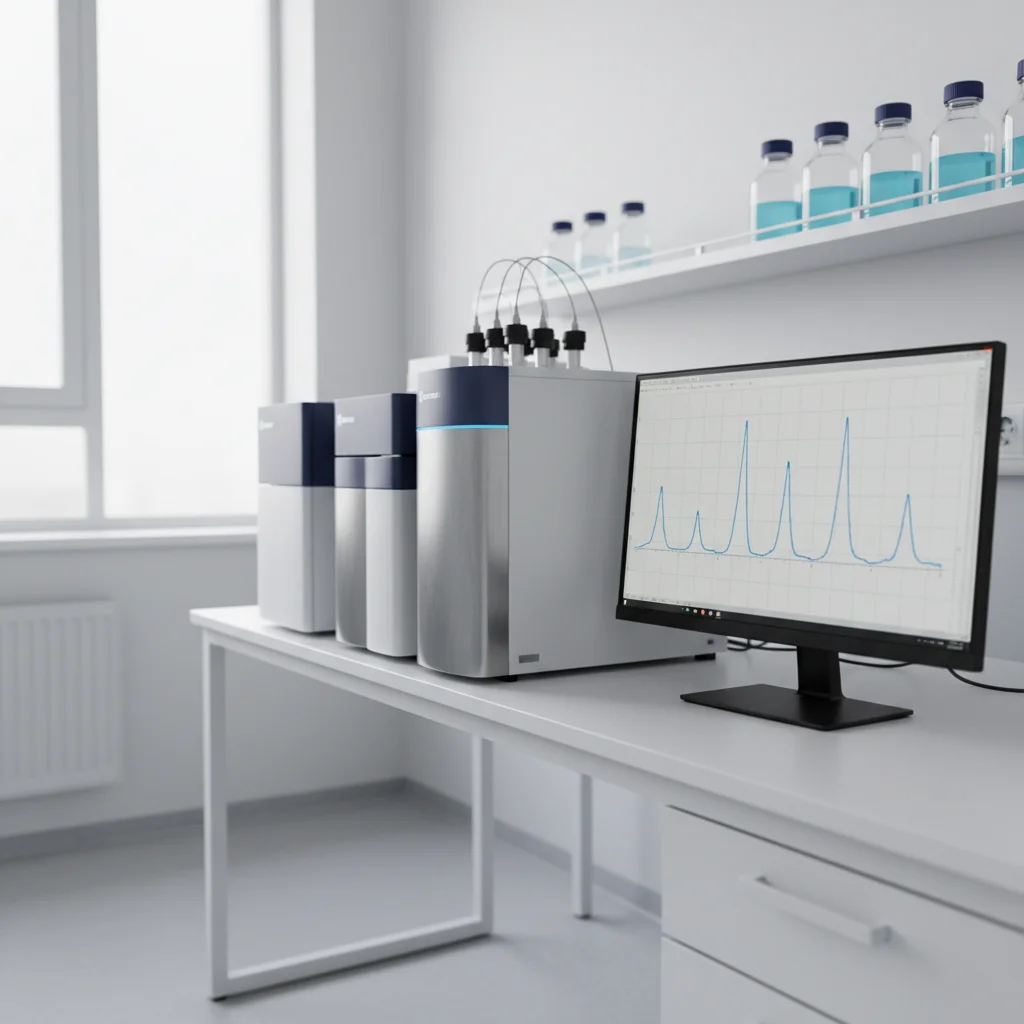
What HPLC analysis means in peptide research
Imagine a bag of coloured balls that you want to sort by size. Scientists do something similar with molecules, except that instead of their hands they use an instrument called HPLC. It is one of the most common ways to check what a sample really contains. Let’s look at how it works in plain words.
What is HPLC?
HPLC is an abbreviation for high-performance liquid chromatography (often described as high-pressure liquid chromatography). It sounds complicated, so let’s picture it as a race.
At the start, all the runners stand together at the starting line. But some are fast and others slower. At the end of the race, they cross the finish line at different times. HPLC works in exactly the same way: different molecules travel through a thin tube (the column) at different speeds and “finish” at different times. This makes it possible to separate them from one another.
If you want a quick reminder of what peptides are: they are small protein-like molecules made of linked chains of amino acids. It is precisely such materials that are often studied with this method.
How it works, step by step
The whole process can be broken down into a few simple stages:
- Sample preparation. The material being studied is dissolved in a liquid.
- Injection. A small droplet is injected into the system.
- Journey through the column. High pressure pushes the liquid through a column packed with tiny particles. Some molecules “stick” to them longer, while others run through faster.
- Detection. At the end of the column there is a detector – like a finish-line judge that records when each molecule passes.
In the laboratory, this whole journey takes from a few minutes to about half an hour.
What a chromatogram is and how to “read” it
The result recorded by the detector is called a chromatogram. It is a simple graph: time on the horizontal axis and signal strength on the vertical axis.
The graph shows peaks – sharp little hills. Each peak represents a separate component of the material that “finished” at a certain time.
- The position of a peak (when it appeared) helps identify what molecule it may be.
- The size of a peak (its height or area) shows how much of that substance is in the sample.
- A single clear peak usually means the sample is fairly homogeneous, while many small additional peaks mean it also contains other impurities.
Why this is useful in research
HPLC is valued in the laboratory because it shows the composition of a material – like opening up its “ingredients label”. This is especially important in peptide research.
- You can examine whether a sample contains only the molecule being studied or also foreign impurities.
- You can compare different samples with each other.
- You can monitor whether the composition of a material changes over time.
It is precisely because of this clarity that HPLC has become one of the main tools for examining the properties of peptides in the laboratory. If you are interested in which materials are typically studied, you can browse our catalogue.
Brief summary
HPLC is a way of separating molecules by how quickly they “race” through the column. The result is shown in a chromatogram, where the peaks reveal the individual components and their amounts. It is a simple but very informative tool for scientific work.
Important: all peptides and materials discussed in this article are intended solely for laboratory and scientific research (in vitro). They are not intended for human or animal consumption, are not medicines or dietary supplements, and may not be used for diagnosis or treatment.
Frequently asked questions
Why do different molecules leave the column at different times?
The column is a thin tube packed with tiny particles, and high pressure pushes liquid through it. Some molecules “stick” to those particles longer while others run through faster, so they “finish” at different times. It is this difference in speed that makes it possible to separate the components of a sample from one another.
What does the position of a peak show, and what does its size show in a chromatogram?
A chromatogram is a simple graph: time is plotted on the horizontal axis and signal strength on the vertical axis. The position of a peak – i.e. the time at which it appeared – helps identify what molecule it may be. The size of the peak, its height or area, shows how much of that substance is in the sample, so a single graph gives information about both composition and quantity.
How can you tell from a chromatogram whether a sample contains impurities?
A single clear peak usually means the sample is fairly homogeneous. If many small additional peaks are visible next to it, the sample also contains other impurities. This is why the method makes it possible to examine whether a sample contains only the molecule being studied or other substances as well.
How long does one analysis take, and what else is it used for?
In the laboratory, the whole journey through the system takes from a few minutes to about half an hour. Besides assessing the composition of a sample, the same method can be used to compare different samples with each other or to monitor whether the composition of a material changes over time. Because of this clarity, HPLC has become one of the main tools for examining the properties of peptides in the laboratory.