
Your cart is empty
Start shopping
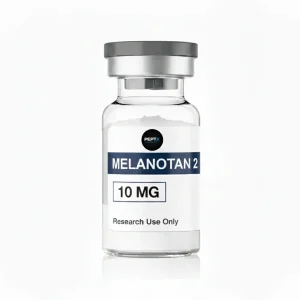
What is Melanotan 2 (Melanotan II)
One key that opens not one but several different cellular “locks” – this is the analogy researchers use to describe Melanotan 2. It is a molecule that, in laboratory models, binds and activates the whole melanocortin receptor family, which has made it a classic tool for studying the mechanisms of this signalling system. In this knowledge-base article we explain what the molecule is, how it is built and how it is studied in vitro – from a strictly scientific, not a consumer, angle.
What is Melanotan 2
Melanotan 2 (Melanotan II, often abbreviated MT-2) is a synthetic peptide – a laboratory-designed analogue of natural α-melanocyte-stimulating hormone (α-MSH). α-MSH is a signalling peptide of the melanocortin family found in the body, and Melanotan 2 was designed as a more stable, longer-acting version of it for research. If you are just getting to know this group of compounds, it is useful to look at the foundational article what are peptides – it explains how amino acid chains become signalling molecules in the first place.
Origin and research history
Melanotan 2 was synthesised in the 1980s–1990s by a research group at the University of Arizona that was systematically examining the structure–activity relationships of α-MSH. The aim was to obtain a compact, enzyme-resistant α-MSH analogue convenient for studying melanocortin receptor signalling. Other melanocortin agonists later emerged from the same line of research, which is why Melanotan 2 is often regarded in the literature as a foundational tool compound in this field of molecular pharmacology.
Class and chemical structure
Melanotan 2 belongs to the class of neuropeptides and melanocortin agonists. Structurally, it is a cyclic heptapeptide whose formula is usually written as Ac-Nle-cyclo(-Asp-His-D-Phe-Arg-Trp-Lys)-NH₂.
- Cyclic structure: the molecule is closed into a ring by a lactam bridge between the Asp and Lys residues. This “locking” makes it much more resistant to enzymatic degradation than linear α-MSH.
- Modified residues: compared with the natural hormone, the termini are shortened and non-standard amino acids are inserted at key positions (Nle instead of Met, D-Phe instead of L-Phe). These changes stabilise the active form of the molecule.
- Pharmacophore: the His-Phe-Arg-Trp sequence is the core recognised by melanocortin receptors – it is what determines binding.
The mechanism of action studied
In the scientific literature, Melanotan 2 is described as a non-selective melanocortin receptor agonist. In cell models it binds to several subtypes of this family (MC1R, MC3R, MC4R and MC5R) and activates them with relatively similar affinity, unlike natural α-MSH, which leans more towards MC1R.
- MC1R and melanogenesis: in in vitro melanocyte cultures, receptor activation is studied as a signal that raises intracellular cAMP via the Gs protein and modulates the activity of tyrosinase – the pigment-synthesising enzyme – and eumelanin production. This is the main research model for melanogenesis.
- MC3R / MC4R: these receptors are studied mainly in cellular systems, examining central nervous system signalling and energy metabolism.
- cAMP cascade: in all cases, the main readout measured in vitro is the Gs protein-mediated change in cAMP signalling in transfected cells expressing a specific receptor.
Because the molecule acts on the melanocortin axis, it is often compared in research with a related compound – this is discussed in more detail in the article what is PT-141, which emerged from the very same Melanotan 2 line of research.
The melanocortin receptor family in research
The melanocortin receptors form a family of five subtypes, and in research each of them is examined in different cell models:
- MC1R: models of pigmentation and melanocyte biology.
- MC2R: specifically recognises ACTH, and Melanotan 2 does not activate it significantly, so this subtype usually stays on the sidelines in in vitro research.
- MC3R and MC4R: targets for central nervous system and energy balance signalling in cellular systems.
- MC5R: most often studied in cell models of exocrine glands.
Research models
In laboratories, Melanotan 2 is characterised by examining well-defined cell systems rather than living organisms:
- Receptor binding assays: affinity and selectivity are measured in HEK293 or similar cell lines artificially expressing a single MCxR subtype.
- Functional cAMP assays: the degree of receptor activation (agonist potency and efficacy) is assessed.
- Melanocyte cultures: changes in tyrosinase activity and melanin content in vitro are used as a marker of melanogenesis.
You will find a broader map of this group of peptides in the full overview article neuropeptides for research.
Quality and handling in the laboratory
A cyclic peptide is sensitive to environmental and handling conditions, so the reliability of research depends directly on the purity of the material and proper storage:
- Confirming purity: identity and purity are usually confirmed chromatographically – how this is done is described in the article HPLC analysis in peptide research.
- Storage and reconstitution: the lyophilised form is the most stable; correct thawing, reconstitution and storage are covered in the guide storing and reconstituting lyophilised peptides.
- Reproducibility: a uniform reconstitution procedure and an unbroken cold chain are essential for in vitro results to be reproducible between experiments.
A closing note for researchers
In the scientific literature, Melanotan 2 is of interest primarily as a tool for studying the mechanisms of melanocortin receptor signalling and melanogenesis in cell models. The molecule is examined as a research subject, not as something useful for any living system.
Important: this material is intended solely for in vitro scientific and laboratory research. It is not a medicine, dietary supplement or cosmetic product and is not intended for human or animal consumption, or for the diagnosis, treatment or prevention of disease. The information in this article is educational only, describes the published in vitro research context and is not any kind of dosing, usage or health recommendation.
Frequently asked questions
Which in vitro models and mechanisms are used to study Melanotan 2?
In the scientific literature, Melanotan 2 is examined as a non-selective melanocortin receptor agonist in cell models. Receptor binding assays (for example, in HEK293 or similar lines artificially expressing a single subtype) measure its affinity and selectivity for MC1R, MC3R, MC4R and MC5R. In functional assays, the main readout is the Gs protein-mediated change in intracellular cAMP signalling in transfected cells. In melanocyte cultures, MC1R activation is studied as a signal that modulates tyrosinase activity and eumelanin production, so changes in tyrosinase activity and melanin content are used as a marker of melanogenesis. MC3R and MC4R are examined mainly in cellular systems studying central nervous system signalling and energy metabolism, while MC5R is most often studied in cell models of exocrine glands.
How is the quality of Melanotan 2 ensured, and how is it handled in the laboratory?
A cyclic peptide is sensitive to environmental and handling conditions, so the reliability of research depends directly on the purity of the material and proper storage. Identity and purity are usually confirmed chromatographically using HPLC analysis. The lyophilised form is the most stable, so correct thawing, reconstitution and storage according to the recommendations for handling lyophilised peptides are important. A uniform reconstitution procedure and an unbroken cold chain are essential for in vitro results to be reproducible between experiments.
How does Melanotan 2 differ from natural α-MSH?
Melanotan 2 is a synthetic analogue of natural α-melanocyte-stimulating hormone (α-MSH), designed as a more stable version that is more convenient for research. Structurally, it is a cyclic heptapeptide closed into a ring by a lactam bridge between the Asp and Lys residues; this locking makes it much more resistant to enzymatic degradation than linear α-MSH. Compared with the natural hormone, its termini are shortened and non-standard amino acids are inserted at key positions (Nle instead of Met, D-Phe instead of L-Phe), stabilising the active form. In addition, in cell models it is less selective and activates several melanocortin receptor subtypes (MC1R, MC3R, MC4R, MC5R) with relatively similar affinity, unlike α-MSH, which leans more towards MC1R.
Are these materials intended for human use?
No. Melanotan 2 and other materials in this group are intended solely for in vitro scientific research in the laboratory. It is not a medicine, dietary supplement or cosmetic product and is not intended for human or animal consumption, or for the diagnosis, treatment or prevention of disease. The information provided is educational only and is not any kind of dosing, usage or health recommendation.