
Your cart is empty
Start shopping
Neuropeptides for research: Semax, Selank and other signalling peptides
Signals in the nervous system travel at two speeds: classic neurotransmitters transmit an impulse within milliseconds, whereas neuropeptides act more slowly and subtly – as longer-lasting regulators. It is precisely this slow, modulatory nature that makes them so attractive for laboratory research. In this knowledge-base article we review the neuropeptide class and the main in vitro research directions related to compounds such as Semax, Selank, oxytocin and DSIP.

What are neuropeptides
Neuropeptides are peptide molecules synthesised in organisms by nerve cells and some other cells. Structurally, they sit between small signalling molecules and large proteins: they usually consist of anything from a few to several dozen amino acids. Unlike classic neurotransmitters, neuropeptides often act more slowly and for longer, and in laboratory models their signal is associated with specific receptors on the cell surface. We describe the general structure of peptides in more detail in the article “What are peptides”.
In the research context, neuropeptides are attractive because their sequence is precisely defined and can be reproduced synthetically. This allows scientists to create stabilised analogues – replacing or adding amino acids so that the molecule remains intact for longer in the test medium. Many of the compounds described below are exactly that: they are derived from natural peptides but extended with short fragments that increase their resistance to enzymes under laboratory conditions.
Semax – an ACTH fragment analogue
Semax is a synthetic heptapeptide derived from the adrenocorticotropic hormone fragment ACTH(4–10), to which a Pro-Gly-Pro chain has been added. The scientific literature states that this extension increases the molecule’s resistance to enzymatic degradation and removes the steroidogenic (adrenal-stimulating) activity of the parent ACTH.
In in vitro and preclinical models, Semax is studied as a neurotrophic signalling peptide: work with glial cell cultures has observed changes in the messenger RNA expression of neurotrophins – brain-derived neurotrophic factor (BDNF) and nerve growth factor (NGF). The literature mentions interaction with the melanocortin receptor MC4R as a possible mechanism of action. Semax belongs to the broad neuropeptide category; we examine its structure and research models separately in the article “What is Semax”.
Selank – a tuftsin analogue
Selank is a synthetic heptapeptide (sequence Thr-Lys-Pro-Arg-Pro-Gly-Pro) created from the endogenous immunomodulatory peptide tuftsin by adding a Pro-Gly-Pro fragment to its C-terminus. This stabilisation extends the molecule’s half-life in the laboratory medium.

In research models, Selank is interesting because it does not bind strongly to classic GABA, opioid or serotonin receptors. Instead, in vitro work with transfected cell lines shows an indirect effect – changes in the expression of GABA-A receptor α₂ and α₃ subunits and in receptor stoichiometry. Radioligand studies (e.g. with [³H]muscimol) on cell membrane preparations are used to assess how the peptide changes GABA binding properties. This is a purely molecular-level research direction.
Oxytocin – a nonapeptide and GPCR signalling
Oxytocin is a nonapeptide made up of nine amino acids, studied in laboratories as a ligand of its own receptor (OXTR) – a G protein-coupled receptor (GPCR). In in vitro cell cultures, the interaction of oxytocin with OXTR is associated with the phospholipase C pathway, changes in intracellular calcium (Ca²⁺) concentration and activation of MAPK cascades – for example, ERK phosphorylation in cells that express OXTR. In research, OXTR is also compared with the structurally related nonapeptide vasopressin, which binds more weakly to the same receptor. These properties make oxytocin a convenient model compound for studying receptor signalling mechanisms in astrocyte and neuronal cell systems.

DSIP – a still unsolved puzzle
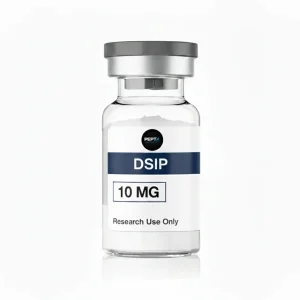
DSIP (delta sleep-inducing peptide) is a nonapeptide with the sequence Trp-Ala-Gly-Gly-Asp-Ala-Ser-Gly-Glu; it was first isolated back in 1977. Despite several decades of work, the exact DSIP receptor and cellular mechanism of action remain unexplained in the literature – a review by Kovalzon and Strekalova (Journal of Neurochemistry, 2006) calls DSIP “a still unresolved riddle”. In vitro studies observe its antioxidant activity (scavenging of reactive oxygen species) and relatively short molecular stability due to specific aminopeptidases. It is precisely this uncertainty that makes DSIP interesting for fundamental laboratory research.
Quality and handling in the laboratory
Neuropeptides are sensitive compounds, so the reproducibility of research depends directly on the purity of the material and proper handling. The key aspects:
- Purity. The identity and purity of a compound are confirmed in the laboratory by chromatography – read more about this in the article “HPLC analysis in peptide research”.
- Storage and reconstitution. Lyophilised peptides are kept cold and protected from moisture; we describe the reconstitution procedure in our article on storage and reconstitution.
- Stability. Some neuropeptides (e.g. DSIP) break down in the test medium within minutes, so experimental conditions must be carefully controlled.
Summary
Neuropeptides are a broad class of short signalling molecules, each studied in laboratories through its own receptors and cellular models: Semax in the context of neurotrophin expression, Selank in models of GABA-A subunit expression, oxytocin in GPCR signalling research, and DSIP as a compound whose mechanism is still unexplained. You can browse the whole class in the neuropeptide category.
Important note. All compounds described in this article are intended solely for scientific and laboratory in vitro research. They are not medicines, dietary supplements or cosmetics and are not intended for human or animal consumption, or for the diagnosis, treatment or prevention of disease. The information provided is purely educational and scientific in nature and must not be understood as a health, dosing or usage recommendation.
Frequently asked questions
Which in vitro models and mechanisms of neuropeptide research does this article cover?
The article discusses molecular-level research directions for each compound separately. Semax is examined in glial cell cultures by monitoring changes in the messenger RNA expression of the neurotrophins BDNF and NGF, and its possible interaction with the melanocortin receptor MC4R. Selank is studied in transfected cell lines by assessing the expression of GABA-A receptor α2 and α3 subunits and radioligand binding (e.g. [3H]muscimol) in membrane preparations. Oxytocin is used as an OXTR (GPCR) ligand associated with the phospholipase C pathway, changes in intracellular Ca2+ and MAPK/ERK cascades. DSIP is studied for its antioxidant activity (scavenging of reactive oxygen species) and molecular stability. All of these are purely laboratory in vitro research directions.
How should the quality and proper handling of neuropeptides be ensured in the laboratory?
Neuropeptides are sensitive compounds, so the reproducibility of research depends on the purity and handling of the material. The identity and purity of a compound are confirmed by chromatography (HPLC analysis). Lyophilised peptides are kept cold and protected from moisture, following the specified reconstitution procedure. Attention must be paid to stability: some neuropeptides, such as DSIP, break down in the test medium within minutes due to specific aminopeptidases, so experimental conditions must be carefully controlled.
How do neuropeptides differ from classic neurotransmitters?
According to the article, classic neurotransmitters transmit an impulse within milliseconds, whereas neuropeptides act more slowly and for longer, as subtler, longer-lasting regulators. Structurally, neuropeptides sit between small signalling molecules and large proteins – they consist of anything from a few to several dozen amino acids. In laboratory models their signal is associated with specific receptors on the cell surface. Because their sequence is precisely defined and can be reproduced synthetically, scientists create stabilised analogues so that the molecule remains intact for longer in the test medium.
Are these materials intended for human use?
No. All compounds described in the article are intended solely for scientific and laboratory in vitro research. They are not medicines, dietary supplements or cosmetics and are not intended for human or animal consumption, or for the diagnosis, treatment or prevention of disease. The information provided is purely educational and scientific in nature.