
Your cart is empty
Start shopping
What is Ipamorelin
Among the compounds used to study growth hormone secretion signals, Ipamorelin stands out for one feature – receptor precision. In the laboratory it activates one specific receptor and leaves neighbouring signalling pathways almost untouched, which has made it a convenient reference compound in receptor pharmacology research in the scientific literature. In this knowledge-base article we explain what the molecule is, what its structure looks like and which in vitro mechanism the research describes.
What is Ipamorelin
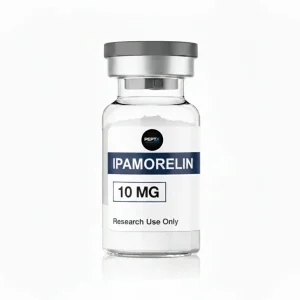
Ipamorelin (original designation NNC 26-0161) is a synthetic pentapeptide – a chain of five amino acid residues. If you are not sure how a peptide differs from a protein or a single amino acid, it is worth starting with the basics in the article What are peptides.
The molecule was described in 1998 by researchers at Novo Nordisk (Raun and colleagues). It belongs to the class of growth hormone secretagogues – compounds that interact with a specific receptor in research models and are studied as tools for analysing the signalling pathways of growth hormone secretion. We give a broader picture of this group in the overview Research peptides for growth hormone secretion, and you will find the product category under Growth hormone secretion.
Structure
The amino acid sequence of Ipamorelin is written as Aib-His-D-2-Nal-D-Phe-Lys-NH₂. Several details of this sequence matter precisely from a scientific point of view:
- Aib (α-aminoisobutyric acid) – a non-standard amino acid that gives the chain structural rigidity and a defined conformation.
- D-2-Nal (D-2-naphthylalanine) and D-Phe – D-configuration residues that, in the laboratory, are associated with greater resistance of the molecule to enzymatic degradation.
- C-terminal amide (-NH₂) – a modification typical of many synthetic research peptides.
Interestingly, Ipamorelin was identified in a series of compounds that lacked the central Ala-Trp dipeptide characteristic of the earlier growth hormone-releasing peptide GHRP-1. It is precisely this structural detail that gave the molecule its unique behaviour in research models.
The combination of non-standard and D-configuration residues makes the molecule compact, conformationally defined and relatively stable in the laboratory – properties that matter for obtaining reproducible research results.
The in vitro mechanism studied
In the scientific literature, Ipamorelin is described as a selective agonist of the GHS-R1a receptor (growth hormone secretagogue receptor subtype 1a) – the same receptor activated by the endogenous peptide ghrelin. GHS-R1a belongs to the G protein-coupled receptor (GPCR) family.
The signalling pathway described in cell models looks like this: once bound to GHS-R1a, the compound initiates Gq/11-mediated activation of phospholipase C, followed by the formation of IP₃ and the release of intracellular calcium (Ca²⁺). This is a classic GPCR signalling cascade that researchers monitor in vitro as a marker of receptor activation.
The property most emphasised in the literature is selectivity. Unlike earlier compounds in this class (e.g. GHRP-6 or hexarelin), Ipamorelin is described in research models as not causing a significant change in cortisol, ACTH or prolactin signalling. It was because of this “clean” receptor interaction that Raun and colleagues, in their 1998 paper, called it the first selective growth hormone secretagogue – which made it a convenient comparison tool in receptor pharmacology research.
For researchers, selectivity matters as a methodological property: the fewer receptors a compound touches at once, the easier it is to tell in an experiment which signalling pathway causes the observed cellular response. That is why Ipamorelin is often used in the literature as a reference compound against which the behaviour of less selective growth hormone secretagogues is compared in the same cell lines.
These data are observations from cellular and laboratory models only. They describe the molecular behaviour of the receptor, not any effect on the human or animal body.
Quality and handling in the laboratory
The reproducibility of research depends directly on the purity of the material and proper storage. A few practical guidelines:
- Identity and purity. The composition of the peptide and the level of impurities are usually checked by chromatographic methods – more on this in the article HPLC analysis in peptide research.
- Storage. Lyophilised (freeze-dried) peptides are sensitive to moisture and temperature; the principles of correct storage and reconstitution are described in Storing and reconstituting lyophilised peptides.
- Documentation. Every batch should have a certificate of analysis that makes it possible to trace identity and purity.
Related molecules
In research on the signalling pathways of growth hormone secretion, Ipamorelin is often compared with other molecules in this category, such as CJC-1295 or Sermorelin, which act through a different receptor.
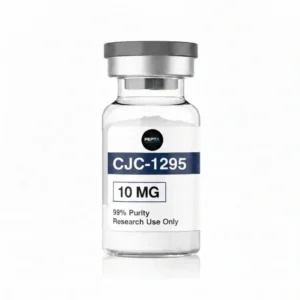
It is worth stressing that in research models these two compounds belong to a different mechanism – they are described as analogues acting on the growth hormone-releasing hormone receptor (GHRHR), not as GHS-R1a agonists. So when molecules of both types are studied at the same time, an experiment can show how two separate signalling pathways – GHRHR and GHS-R1a – contribute to the overall receptor response in a cell model. We review the whole group systematically in Research peptides for growth hormone secretion.
Closing note
Ipamorelin is a structurally well-defined synthetic pentapeptide whose selective interaction with the GHS-R1a receptor has made it a useful tool in in vitro receptor pharmacology research. All information presented here is educational and scientific in nature and describes the molecule as a subject of research.
Restriction of use. This product and this article are intended solely for scientific research and laboratory use (research use only). The material is not a medicine, dietary supplement or cosmetic product. It is not intended for human or animal consumption, diagnosis, treatment or prevention. The article contains no dosing, health or therapeutic recommendations.
Frequently asked questions
Which in vitro mechanism and models does the scientific literature on Ipamorelin study?
In cell models, Ipamorelin is described as a selective agonist of the GHS-R1a receptor (growth hormone secretagogue receptor subtype 1a) – the same GPCR-family receptor activated by endogenous ghrelin. Once bound to GHS-R1a, the compound initiates Gq/11-mediated activation of phospholipase C, followed by the formation of IP3 and the release of intracellular calcium (Ca2+). Researchers monitor this classic GPCR signalling cascade in vitro as a marker of receptor activation. All these data are observations from cellular and laboratory models only, describing the molecular behaviour of the receptor rather than any effect on the body.
How is the material handled and its quality checked in the laboratory?
The reproducibility of research depends on purity and proper storage. The identity of the peptide and the level of impurities are usually checked by chromatographic methods, such as HPLC analysis. Lyophilised (freeze-dried) peptides are sensitive to moisture and temperature, so it is important to follow the correct storage and reconstitution principles. Every batch should have a certificate of analysis that makes it possible to trace identity and purity.
How does Ipamorelin differ from CJC-1295 or Sermorelin?
In research models, Ipamorelin is described as a GHS-R1a receptor agonist. CJC-1295 and Sermorelin belong to a different mechanism – they are described as analogues acting on the growth hormone-releasing hormone receptor (GHRHR), not as GHS-R1a agonists, i.e. they act through a different receptor. So when molecules of both types are studied at the same time, an experiment can show how two separate signalling pathways (GHRHR and GHS-R1a) contribute to the overall receptor response in a cell model. Ipamorelin is also used as a reference compound in the literature, as Raun and colleagues called it the first selective growth hormone secretagogue in their 1998 paper.
Are these materials intended for human use?
No. Ipamorelin and this article are intended solely for in vitro scientific research and laboratory use (research use only). The material is not a medicine, dietary supplement or cosmetic product. It is not intended for human or animal consumption, diagnosis, treatment or prevention. The article contains no dosing, health or therapeutic recommendations.