
Your cart is empty
Start shopping
Research peptides for growth hormone secretion: Ipamorelin, CJC-1295 and Sermorelin
Somatotroph cells of the anterior pituitary do not release growth hormone (GH) evenly but in pulsatile bursts, whose rhythm is set by the balance of opposing signals. Molecular biology research has long sought compounds capable of modulating this secretory pulse in vitro. This brought two separate peptide families to the fore, reaching somatotroph cells through different receptors – GHRH analogues and ghrelin receptor secretagogues. In this article we compare, as subjects of scientific research, the three molecules most often studied in laboratories – Sermorelin, CJC-1295 and Ipamorelin.
What are growth hormone secretion peptides
They are a group of peptides studied in cellular and laboratory models for their ability to modulate the release of growth hormone (GH) from somatotroph cells of the anterior pituitary. Unlike GH itself, these compounds are relatively short amino acid chains that interact with specific receptors on the cell surface. You will find a broader overview of this class in the growth hormone secretion category, and the general concept of peptides in the article “What are peptides”.
Two molecular approaches
In the research literature, these molecules are grouped by the receptor they bind to:
- GHRH analogues (Sermorelin, CJC-1295) – mimic natural growth hormone-releasing hormone (GHRH) and bind to the GHRH receptor (GHRHR), which belongs to the class B G protein-coupled receptors.
- Secretagogues / ghrelin receptor agonists (Ipamorelin) – bind to a different target, the GHS-R1a (ghrelin) receptor.
Because the two signalling pathways reach somatotroph cells through different receptors, in in vitro models they are often studied both separately and together to understand how the signals interact. At the molecular level, GHRH analogues act mainly through the cAMP cascade, while the ghrelin receptor activates a separate, calcium (Ca²⁺)-dependent signalling pathway. Compounds studied together make it possible to observe how the two streams converge in the same cell.
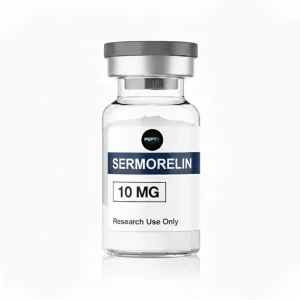
Sermorelin – the GHRH(1–29) fragment
Sermorelin is a synthetic 29-amino-acid N-terminal fragment of natural 44-amino-acid GHRH (GHRH 1–29-NH₂). Research has shown that this short fragment retains the full ability of the parent molecule to activate the receptors. In laboratory models it is described as a GHRH receptor agonist: once bound to GHRHR, it activates the Gαs / adenylate cyclase / cAMP signalling pathway, which is associated with GH gene transcription and secretion. A characteristic property is its short half-life (about 10–20 minutes), because the molecule is quickly broken down by the enzyme dipeptidyl peptidase IV (DPP-IV).
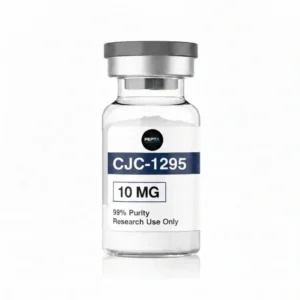
CJC-1295 – a modified long-acting GHRH analogue
CJC-1295 is a GHRH analogue modified to be more resistant to enzymatic degradation. The variant with the so-called DAC (drug affinity complex) carries a maleimidopropionyl linker that binds covalently to cysteine-34 of circulating albumin. A study by Teichman and colleagues (JCEM, 2006) described how this modification greatly extends the molecule’s lifetime in the body. Two forms of CJC-1295 are found in the literature: with DAC and without it (often called “modified GRF 1–29”). The latter has no albumin linkage, so in in vitro models it has a shorter action profile, similar to Sermorelin. The DAC variant is used where a longer and more stable GHRH signal is needed. At the receptor level, CJC-1295, like Sermorelin, acts through GHRHR and the cAMP cascade – what differs is not the molecular target but pharmacokinetic stability, which makes this compound convenient as a longer-acting probe of the GHRH pathway in laboratory experiments.
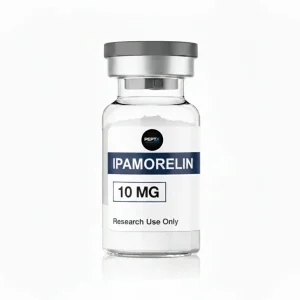
Ipamorelin – a selective secretagogue
Ipamorelin belongs to a different peptide family. It is a pentapeptide (Aib-His-D-2-Nal-D-Phe-Lys-NH₂) that binds not to the GHRH receptor but to the ghrelin receptor GHS-R1a. In the original work by Raun and colleagues (European Journal of Endocrinology, 1998) it was presented as “the first selective growth hormone secretagogue”: in research models it showed high GH-releasing activity without the additional changes in ACTH, cortisol, prolactin or gonadotropin levels typical of earlier GHRP compounds. It is precisely this selectivity that made it a popular comparator. You will find a more detailed description of this molecule in a separate article, “What is Ipamorelin”.
Comparison in a laboratory context
- Target: Sermorelin and CJC-1295 – the GHRH receptor (GHRHR); Ipamorelin – the ghrelin receptor (GHS-R1a).
- Structure: Sermorelin – a 29-amino-acid fragment; CJC-1295 – a modified, stabilised analogue; Ipamorelin – a compact pentapeptide.
- Signalling pathway: both GHRH analogues rely on the cAMP cascade; the secretagogue acts through a separate ghrelin receptor pathway.
- Research value: their different signalling pathways make these molecules especially useful in combined in vitro models studying signal overlap and synergy.
It is important to stress that all these data come from the literature on cell cultures, animals or early clinical studies and are presented here only to deepen understanding of the molecular mechanisms, without any recommendations for practical use.
Quality and handling in the laboratory
For receptor research results to be reliable and reproducible, the purity of the material and its proper handling are especially important. Peptide identity and purity are usually confirmed by analytical methods – read about this in the article “HPLC analysis in peptide research”. Because these compounds are supplied lyophilised and are sensitive to moisture and temperature, it is worth reviewing the guidelines on storing and reconstituting lyophilised peptides before an experiment – improper storage can distort the data of any in vitro model.
For scientific research only
This article is educational in nature and is intended exclusively as an overview of the laboratory, in vitro scientific context. Sermorelin, CJC-1295 and Ipamorelin are described here only as research subjects. These compounds are not medicines, dietary supplements or cosmetics, and are not intended for human or animal consumption, or for diagnosis, treatment or prevention. The text makes no dosing, health or benefit claims. The materials may be handled only by qualified researchers in a controlled environment, in compliance with applicable law and laboratory safety requirements.
Frequently asked questions
Which in vitro mechanisms and signalling pathways are studied with growth hormone secretion peptides?
In cellular and laboratory models, these peptides are studied for their ability to modulate the release of growth hormone (GH) from somatotroph cells of the anterior pituitary. There are two molecular approaches, depending on the receptor: GHRH analogues (Sermorelin, CJC-1295) bind to the GHRH receptor (GHRHR) and act through the Gαs / adenylate cyclase / cAMP cascade, while secretagogues (Ipamorelin) bind to the ghrelin receptor GHS-R1a and activate a separate, calcium (Ca²⁺)-dependent pathway. Because of their different targets, they are often studied in vitro both separately and together to observe how the signals interact and converge in the same cell.
How should these peptides be handled and stored in the laboratory so that research results are reproducible?
For receptor research results to be reliable and reproducible, the purity of the material and proper handling are important. Peptide identity and purity are usually confirmed by analytical methods such as HPLC analysis. These compounds are supplied lyophilised and are sensitive to moisture and temperature, so the guidelines on storing and reconstituting lyophilised peptides must be followed before an experiment – improper storage can distort the data of any in vitro model. The materials may be handled only by qualified researchers in a controlled environment.
How do the GHRH analogues (Sermorelin, CJC-1295) differ from the secretagogue Ipamorelin?
The main difference is the molecular target and the structure. Sermorelin and CJC-1295 are GHRH analogues that bind to the GHRH receptor (GHRHR) and rely on the cAMP cascade; Ipamorelin is a compact pentapeptide that binds to the ghrelin receptor GHS-R1a and acts through a separate signalling pathway. Structurally, Sermorelin is a 29-amino-acid GHRH fragment, CJC-1295 is a modified analogue that is more resistant to enzymatic degradation (the DAC variant binds covalently to albumin), and Ipamorelin is described in the literature as a selective secretagogue. Because of their different pathways, these molecules are especially useful in combined in vitro models studying signal overlap.
Are these materials intended for human use?
No. Sermorelin, CJC-1295 and Ipamorelin are described here only as research subjects and are intended exclusively for in vitro scientific laboratory research. These compounds are not medicines, dietary supplements or cosmetics, and are not intended for human or animal consumption, or for diagnosis, treatment or prevention. The text makes no dosing, health or benefit claims. The materials may be handled only by qualified researchers in a controlled environment, in compliance with applicable law and laboratory safety requirements.