
Your cart is empty
Start shopping
Metabolism research peptides and the GLP-1 receptor direction
When a single peptide can activate not one but several related receptors, it becomes a particularly convenient research tool for scientists. Metabolism research peptides are exactly that: in the laboratory they are used to study how a signal is transmitted within a closely related receptor family in cell models. In this knowledge-base article we explain what these compounds are, how the GLP-1 receptor direction is studied in vitro and why Retatrutide has become a frequent subject of such experiments.
What are metabolism research peptides
Peptides are short chains of amino acids joined by peptide bonds. If you want to refresh the basics, the article what are peptides is a good place to start. In the research context, the “metabolism” group describes not an effect on the body but which receptors a compound recognises in cell models. Peptides in this group are used in the laboratory to study signalling pathways related to the regulatory mechanisms of glucose and energy metabolism. You will find a wider selection of such compounds in the metabolism category.
It is important to stress that this describes receptor biochemistry in the test tube and in cell cultures, not any effect on the human or animal body.
GLP-1, GIP and glucagon receptors – three related directions
GLP-1R (the glucagon-like peptide-1 receptor), GIPR (the glucose-dependent insulinotropic polypeptide receptor) and GCGR (the glucagon receptor) belong to the same class B1 family of G protein-coupled receptors (GPCRs). GLP-1 and GIP are so-called incretins – gut-derived peptides whose receptors are often studied alongside the glucagon receptor. Structurally they are related, so a single peptide can recognise more than one of them – in research such compounds are called dual or triple agonists.
Once bound to a class B1 receptor, an agonist usually activates a signalling cascade inside the cell, and its most common marker is a change in the level of the second messenger cAMP. It is precisely this response that scientists measure to assess how strongly, and which, receptors a compound activates.
Retatrutide as an example of a triple agonist
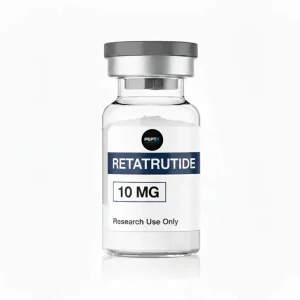
Retatrutide (research code LY3437943) is a synthetic 39-amino-acid peptide built on a GIP peptide scaffold and extended with a C18 fatty acid chain (acylation). This chain allows the molecule to bind reversibly to albumin in solution and thus contributes to its stability. Its relative molecular mass is about 4731 Da. Its structural basis allows the molecule to recognise all three receptors mentioned above at once, which is why the literature describes it as the first triple GLP-1R / GIPR / GCGR agonist.
You will find a more detailed description of the compound – its origin, structure and research context – in a separate article, what is Retatrutide.
How receptor signalling is studied in vitro
The receptor activity of such peptides is usually assessed in cell models in which the receptors of interest are artificially expressed (for example, in HEK293 cells). Typical research methods:
- cAMP accumulation assays – the second-messenger signal is measured for each receptor separately to determine activation potency (EC50).
- Binding assays – these assess how strongly a compound binds to a receptor compared with reference ligands, often in a competitive binding format.
- Selectivity profiling – the response through different receptors is compared to understand the compound’s balance between GLP-1R, GIPR and GCGR.
In the peer-reviewed literature, the receptor profile of LY3437943 was described in work by Coskun and colleagues (Cell Metabolism, 2022). The EC50 values recorded in cAMP assays were approximately 0.064 nM at GIPR, 0.775 nM at GLP-1R and 5.79 nM at GCGR – i.e. the strongest response was obtained through the GIP receptor. These figures illustrate how the behaviour of a triple agonist in cell cultures is described solely in biochemical parameters, without any conclusions about physiological effects.
Quality, purity and handling
Receptor research results are only reliable when the test material is of known purity and identity. That is why the identity and purity of a peptide are usually checked by analytical methods before an experiment – read more about this in the article HPLC analysis in peptide research. Proper storage of the material is just as important: lyophilised peptides are sensitive to moisture and temperature, and improper reconstitution can distort signalling measurements. You will find practical tips in the section storing and reconstituting lyophilised peptides.
Summary
Metabolism research peptides interest scientists as tools that help them understand the signalling of the class B1 GPCR family – the GLP-1, GIP and glucagon receptors – in cell models. Retatrutide is a striking example of a triple agonist whose receptor recognition profile is described purely in biochemical terms. The whole context of such work stays in the laboratory: in cell cultures, test tubes and the data of analytical instruments.
For scientific research only. This article is informational and educational in nature. The compounds described are intended solely for laboratory in vitro research. They are not medicines, dietary supplements or cosmetics, are not intended to diagnose, treat or prevent disease, and are not intended for use in humans or animals. Nothing in this text constitutes medical advice or a dosing recommendation.
Frequently asked questions
Which in vitro models and mechanisms are studied with metabolism research peptides?
In the laboratory, these peptides are used to study the signalling of the class B1 G protein-coupled receptor (GPCR) family in cell models – the GLP-1R, GIPR and GCGR receptor directions. Receptor activity is usually assessed in cells in which the receptors of interest are artificially expressed, for example in the HEK293 line. Typical methods include cAMP accumulation assays to measure the second-messenger signal and determine activation potency (EC50), binding assays to assess binding strength, and selectivity profiling that compares the response through different receptors. What is studied is receptor biochemistry in the test tube and in cell cultures, not effects on the body.
How are the purity and proper handling of peptides ensured before research?
Receptor research results are only reliable when the test material is of known purity and identity. That is why the identity and purity of a peptide are usually checked by analytical methods, such as HPLC analysis, before an experiment. Proper storage is just as important: lyophilised peptides are sensitive to moisture and temperature, and improper reconstitution can distort signalling measurements. For this reason, good storage and reconstitution practice is followed.
How do dual or triple agonists differ from single-receptor peptides, and where does Retatrutide fit in?
GLP-1R, GIPR and GCGR belong to the same class B1 GPCR family and are structurally related, so a single peptide can recognise more than one of them – in research such compounds are called dual or triple agonists. Retatrutide (research code LY3437943) is a synthetic 39-amino-acid peptide built on a GIP scaffold and acylated with a C18 fatty acid chain; the literature describes it as the first triple GLP-1R / GIPR / GCGR agonist. In work by Coskun and colleagues (Cell Metabolism, 2022), the EC50 values recorded in cAMP assays were approximately 0.064 nM at GIPR, 0.775 nM at GLP-1R and 5.79 nM at GCGR – the strongest response was obtained through the GIP receptor. These figures describe the compound in biochemical terms only.
Are these materials intended for human use?
No. The compounds described are intended solely for laboratory in vitro research in cell cultures and test tubes. They are not medicines, dietary supplements or cosmetics, are not intended to diagnose, treat or prevent disease, and are not intended for use in humans or animals. Nothing here constitutes medical advice or a dosing recommendation.