
Your cart is empty
Start shopping
What is Retatrutide
In recent years, one of the most prominent directions in peptide research has been compounds that interact not with one but with several cell receptors at once. One of the most striking examples of such “multi-target” engineering is retatrutide: a synthetic peptide that, in laboratory models, activates three separate receptors at the same time. It is precisely this triple action that makes the molecule so attractive to researchers. In this knowledge-base article we discuss what this compound is, how it is built and how triple receptor agonism is studied under in vitro conditions.
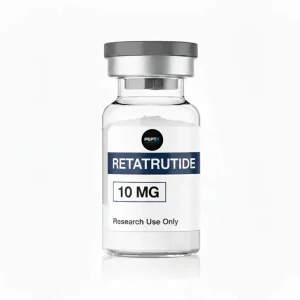
What is retatrutide
Retatrutide (code name LY3437943) is a synthetic peptide classed as an agonist of incretin-system receptors. In research models, this molecule activates receptors that naturally recognise hormones regulating metabolism. If you want a reminder of how a peptide differs from a protein or a hormone, it is worth reading the core article what are peptides.
Retatrutide belongs to the group of metabolism peptides and is one of the most widely studied compounds in this category. The wider context of this group is presented in the thematic article on metabolism peptides for research.
Structure and chemical composition
Structurally, retatrutide is a 39-amino-acid peptide (relative molecular mass about 4731 Da) whose amino acid sequence is derived from the GIP peptide scaffold. Several engineering modifications have been made to the molecule, giving it unique properties in research:
- Non-natural amino acids. Modified amino acid residues (e.g. Aib – α-aminoisobutyric acid) are inserted into the sequence, increasing the peptide’s resistance to enzymatic degradation under laboratory conditions.
- Fatty acid (C18) chain. An octadecanedioic acid (C18 diacid) group is attached to a lysine residue via a linker. In research models, this acylation modification makes the molecule persist longer in samples.
- Amidated terminus. The C-terminal amide (–NH₂) is a typical structural feature of synthetic peptides that increases the stability of the molecule.
Because of this engineered structure, retatrutide behaves differently in laboratory tests than a simple unmodified peptide – the modifications give it greater resistance and define the specificity of its receptor binding.
Triple receptor agonism: what is studied in vitro
The key feature of retatrutide is its ability, in research, to interact with three different receptors at the same time. In cell culture models and receptor activity studies, the following biological targets are monitored:
- GLP-1R – the glucagon-like peptide-1 receptor.
- GIPR – the glucose-dependent insulinotropic polypeptide receptor.
- GCGR – the glucagon receptor.
The concept of triple agonism took shape gradually in the scientific literature. At first, single-target agonists acting only on the GLP-1 receptor were studied; later came dual GIP and GLP-1 receptor agonists, and retatrutide is the continuation of this evolution, combining three signalling pathways in one molecule. This makes it a valuable model molecule for investigating how simultaneous activation of several receptors changes the cellular signalling response compared with stimulating individual receptors.
In vitro receptor activity is most often assessed with cAMP signalling assays: the test peptide is added to cells expressing the receptors and the second-messenger (cAMP) response is measured. According to published data, retatrutide’s half-maximal effective concentrations (EC₅₀) in cAMP assays were about 0.064 nM for the GIP receptor, 0.775 nM for the GLP-1 receptor and 5.79 nM for the glucagon receptor. These data show that under in vitro conditions the molecule activates the GIP receptor most strongly and the other two less intensely; it is precisely this ratio of activity at the individual targets that is the main focus of researchers.
These data are described in a peer-reviewed paper: Coskun et al., “LY3437943, a novel triple glucagon, GIP, and GLP-1 receptor agonist for glycemic control and weight loss: From discovery to clinical proof of concept”, Cell Metabolism, 2022, vol. 34, no. 9. It is precisely such receptor activity profiles that allow scientists to investigate how different signalling pathways interact with each other at the cellular level.
Research models
The mechanism of action of a triple agonist is examined in several stages. First, receptor activity assays are used – genetically modified cells expressing one specific human receptor, so that the influence of each signalling pathway can be assessed precisely. Cell culture models are then used to observe the activation of several receptors at once. Preclinical models also analyse the molecule’s distribution and stability. All these models are intended for a fundamental understanding of the mechanism of action, not for therapeutic or practical application.
Quality and handling in the laboratory
Because retatrutide is supplied lyophilised (freeze-dried), its properties during research depend directly on proper storage and preparation conditions. We write in detail about how to store and reconstitute such compounds correctly in our article on storing and reconstituting lyophilised peptides.
For complex molecules such as retatrutide, confirming purity is especially important – by-product fragments can form during synthesis and may distort the results of receptor interaction studies. Analytical quality control is therefore essential; read more about this in the article HPLC analysis in peptide research.
Summary
Retatrutide is a synthetic 39-amino-acid peptide that, in laboratory models, acts as a triple agonist of the GIP, GLP-1 and glucagon receptors. Its engineered structure and its ability to combine activation of three signalling pathways in one molecule make it an especially valuable subject of fundamental in vitro research on metabolic receptors. For a deeper look at the topic, we recommend the thematic article on metabolism peptides for research.
Important note. Retatrutide is intended for scientific and laboratory research only (research use only). It is not a medicine, dietary supplement or cosmetic product and is not intended for human or animal consumption, or for the diagnosis, treatment or prevention of disease. All information in this article is educational only and describes in vitro and preclinical research contexts.
Frequently asked questions
Which in vitro models and mechanisms do scientists use to study retatrutide?
In laboratory models, retatrutide is studied as a triple receptor agonist that interacts at the same time with the GIP (GIPR), GLP-1 (GLP-1R) and glucagon (GCGR) receptors. First, receptor activity assays are carried out with genetically modified cells expressing one specific human receptor, so that the influence of each signalling pathway can be assessed separately. Activity is most often measured with cAMP second-messenger signalling assays. Cell culture models are then used to observe the activation of several receptors at once. All of this serves to understand the mechanism of action, not practical application.
How should retatrutide be stored and handled in the laboratory?
Retatrutide is supplied lyophilised (freeze-dried), so its properties during research depend directly on proper storage and preparation conditions. Before use, it is important to follow the correct protocol for storing and reconstituting lyophilised peptides. Because it is a complex molecule, confirming purity is especially important: by-product fragments can form during synthesis and may distort the results of receptor interaction studies. Analytical quality control, such as HPLC analysis, is therefore essential.
How does retatrutide differ from single- or dual-target receptor agonists?
The concept of triple agonism took shape gradually in the scientific literature. At first, single-target agonists acting only on the GLP-1 receptor were studied; later came dual GIP and GLP-1 receptor agonists. Retatrutide is the continuation of this evolution, combining three signalling pathways – the GIP, GLP-1 and glucagon receptors – in one molecule. EC50 data published from in vitro cAMP assays show that it activates the GIP receptor most strongly and the other two less intensely. It is precisely this ratio of activity at the individual targets that makes it a valuable model molecule for comparing the activation of several receptors with stimulation of individual receptors.
Are these materials intended for human use?
No. Retatrutide is intended for scientific and laboratory in vitro research only (research use only). It is not a medicine, dietary supplement or cosmetic product and is not intended for human or animal consumption, or for the diagnosis, treatment or prevention of disease. All information in the article is educational only and describes in vitro and preclinical research contexts.