
Your cart is empty
Start shopping
What is BPC-157
Imagine a repair crew that, on receiving a signal about a damaged part of a building, first lays new pipes and cables so that materials can reach the work site at all. It is precisely this logic – “laying” new blood vessels before the tissue itself is rebuilt – that interests scientists who study the peptide BPC-157. It is one of the compounds most frequently studied in laboratories in connection with tissue regeneration and angiogenesis processes in cell models. In this article we look at what kind of molecule it is and in what scientific context it is studied.
What is BPC-157?
The name BPC-157 comes from the English term Body Protection Compound. It is a synthetic peptide whose sequence matches a small fragment of a protein found naturally in human gastric juice. In other words, researchers selected a short, stable amino acid chain from a larger natural molecule and synthesised it separately so that it could be conveniently studied in the laboratory.
If you are just starting to learn about this class of compounds, it is worth reading the introductory article what are peptides – it explains why peptides are short amino acid chains and how they differ from proteins. BPC-157 is exactly this kind of research subject: a molecule studied in the test tube and in cell cultures, not a product intended for consumption.
Structure and class
BPC-157 is classed as a pentadecapeptide, meaning its chain consists of exactly 15 amino acids. The sequence is Gly-Glu-Pro-Pro-Pro-Gly-Lys-Pro-Ala-Asp-Asp-Ala-Gly-Leu-Val. Researchers point to several important features:
- Proline-rich: several proline residues recur in the sequence, giving the chain a degree of rigidity and contributing to the stability of the molecule.
- Relative resistance: under laboratory conditions this fragment shows good stability, which makes it convenient as a model molecule in in vitro experiments.
- Synthetic origin: although the sequence reproduces part of a natural protein, the compound used in research is produced synthetically, which makes it possible to ensure consistent purity.
In vitro mechanisms and models studied
Most of the scientific interest in BPC-157 revolves around angiogenesis – the process of new blood vessel formation – at the cellular level. This is the “pipe-laying” we talked about at the beginning.
In one frequently cited in vitro study (Hsieh et al., Journal of Molecular Medicine, 2017) with human vascular endothelial cells, it was observed that BPC-157 increased the expression of the VEGFR2 receptor – at both mRNA and protein level – although the level of the growth factor VEGF-A itself did not change significantly. The researchers also described VEGFR2 receptor internalisation and subsequent activation of the VEGFR2–Akt–eNOS signalling pathway. Interestingly, adding an endocytosis-inhibiting compound (dynasore) blocked these cellular responses, which allowed the authors to link the observed effect to a specific mechanism.
Endothelial cell behaviour is assessed with classic models such as the tube formation assay and the chorioallantoic membrane (CAM) assay – they show how cells organise themselves into structures resembling blood vessels.
Another line of research concerns fibroblasts. In tendon fibroblast cultures (Chang et al., PMC6271067), increased expression of the growth hormone receptor was observed, and greater cell outgrowth from tendon explant fragments was recorded in vitro at nanomolar concentrations. The researchers also mention the FAK–paxillin signalling pathway, which is associated with cell migration and survival. We provide wider context on the growth hormone secretion peptides used in research in a separate overview. All of this describes mechanisms in cellular and experimental animal models, not conclusions about humans.
Purity, quality and storage
Because research with BPC-157 assesses subtle cellular responses, the quality of the material becomes essential – impurities or a degraded molecule can distort the results. Several things therefore matter in research practice:
- Analytical control: the identity and purity of the compound are usually checked by chromatographic methods. We write about this in more detail in the article HPLC analysis in peptide research.
- Proper storage: lyophilised peptides are sensitive to moisture and temperature, so it is important to know how to store and reconstitute them – there is a separate guide on storing and reconstituting lyophilised peptides.
- Documentation: the certificate of analysis for the batch of material used in research makes it possible to trace purity data and ensure that experiments are reproducible.
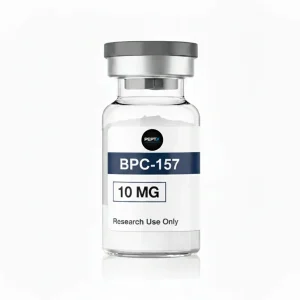
If you are looking for material for laboratory work, you will find the product information on the BPC-157 page.
Key takeaways
BPC-157 is a 15-amino-acid pentadecapeptide whose sequence is derived from a fragment of a protein found in gastric juice. Scientific interest in it focuses on angiogenesis and tissue regeneration processes, studied in endothelial cell and fibroblast cultures and in experimental models. The mechanisms described – increased VEGFR2 expression, the VEGFR2–Akt–eNOS signalling pathway, growth hormone receptor expression – are part of in vitro and preclinical observations. It is important to stress that, according to recent reviews, there are practically no completed controlled clinical studies in humans on this subject, so all knowledge remains at the level of laboratory research.
For scientific research only. This article is informational and educational in nature, intended to introduce the context of laboratory research. BPC-157 is described exclusively as a subject of in vitro research (in cell cultures) and experimental models. This material is not a medicine, dietary supplement or cosmetic product and is not intended for human or animal consumption, or for diagnosis, treatment or prevention. The text contains no dosing or human-use recommendations. The material is intended for qualified scientific and laboratory use only.
Frequently asked questions
Which in vitro mechanisms and models do scientists describe when studying BPC-157?
Most of the research revolves around angiogenesis – the formation of new blood vessels at the cellular level. In in vitro studies with human vascular endothelial cells, increased VEGFR2 receptor expression and activation of the VEGFR2–Akt–eNOS signalling pathway were observed, and endothelial cell behaviour was assessed with tube formation and chorioallantoic membrane (CAM) assays. Another line of research concerns tendon fibroblast cultures, where growth hormone receptor expression and the FAK–paxillin signalling pathway were recorded. All of this describes mechanisms in cellular and experimental models, not conclusions about humans.
Why do the purity and storage of BPC-157 matter in laboratory work?
Because research assesses subtle cellular responses, impurities or a degraded molecule can distort the results, so the quality of the material becomes essential. The identity and purity of the compound are usually checked by chromatographic methods such as HPLC. Lyophilised peptides are sensitive to moisture and temperature, so it is important to know how to store and reconstitute them properly. The batch certificate of analysis makes it possible to trace purity data and ensure that experiments are reproducible.
What makes BPC-157 distinctive as a molecule, and how is it described structurally?
BPC-157 is classed as a pentadecapeptide – its chain consists of exactly 15 amino acids (sequence Gly-Glu-Pro-Pro-Pro-Gly-Lys-Pro-Ala-Asp-Asp-Ala-Gly-Leu-Val). The name comes from the term Body Protection Compound, and the sequence matches a small fragment of a protein found naturally in human gastric juice. Although the sequence reproduces part of a natural protein, the compound used in research is produced synthetically to ensure consistent purity. The abundance of proline in the sequence gives the chain rigidity and contributes to stability, which makes the molecule convenient as a model in in vitro experiments.
Are these materials intended for human use?
No. BPC-157 is described exclusively as a subject of in vitro research (in cell cultures) and experimental models, intended for scientific laboratory research only. This material is not a medicine, dietary supplement or cosmetic product and is not intended for human or animal consumption, or for diagnosis, treatment or prevention. The text contains no dosing or human-use recommendations, and all knowledge remains at the level of laboratory research.