
Your cart is empty
Start shopping
What is Semax
Nature sometimes creates an excellent but short-lived molecule: a natural segment of adrenocorticotropic hormone (ACTH) carries a clear biological message but breaks down quickly in the body, which makes it hard to use in repeated laboratory experiments. Semax is an engineering answer to this problem: a laboratory-designed peptide in which the functional hormone fragment is extended with a stabilising segment. This knowledge-base article examines what Semax is as a research subject – what it is made of, which class it belongs to, and which in vitro mechanisms scientists observe in cell and tissue models.
What is Semax and which class does it belong to
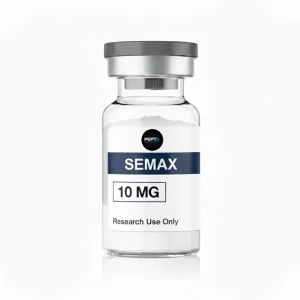
Semax is a synthetic heptapeptide made up of a seven-amino-acid chain. It belongs to the class of neuropeptides – molecules studied in laboratory models for their interaction with cells of the nervous system. Semax was designed as an analogue of the natural ACTH fragment ACTH(4-10), so it can be regarded as an engineered relative of a peptide the body produces itself. The molecule was developed at the end of the 20th century as an investigational peptide, with the aim of obtaining a compound more stable than the natural fragment and suitable for repeated laboratory experiments.
For a deeper introduction to peptide structure and terminology, we recommend the introductory article What are peptides, while the overview article Neuropeptides for research gives a broader picture of this group.
Structure: what Semax is made of
The amino acid sequence of Semax is Met-Glu-His-Phe-Pro-Gly-Pro. The molecule is a hybrid made up of two functionally different parts:
- N-terminal fragment (Met-Glu-His-Phe) – corresponds to the ACTH(4-7) segment and coincides with the analogous region of the α-MSH molecule. This is the “informational” part of the chain, most often associated with neurotropic effects in research models.
- C-terminal tripeptide (Pro-Gly-Pro) – a biogenic suffix added artificially to make the molecule stable. It gives greater resistance to enzymatic degradation and is the “protective envelope” mentioned in the introduction.
Because only the short ACTH(4-7) segment is retained, rather than the whole hormone chain, Semax lacks the steroidogenic (corticotropic) activity typical of natural ACTH – and it is precisely this structural choice that explains why ACTH(4-10)-type fragments are examined in the literature as neurotropic rather than endocrine compounds. This design principle – extending a functional fragment with a stabilising segment – is a classic example from peptide chemistry of how to turn a short-lived molecule into one better suited to repeated laboratory experiments.
The in vitro mechanism and models studied
In the scientific literature, Semax is most often examined for its link with the neurotrophin BDNF (brain-derived neurotrophic factor) and its receptor TrkB. In cell cultures and animal tissue models, the BDNF/TrkB system is a classic target of research on neuronal survival and synaptic plasticity.
In a paper published in 2006 by Dolotov and colleagues (Brain Research), increased BDNF protein levels, increased tyrosine phosphorylation of the TrkB receptor and a corresponding mRNA level were recorded in a rat hippocampal model after exposure to Semax. This allowed the researchers to hypothesise that Semax modulates the expression and activity of the hippocampal BDNF/TrkB system.
Laboratory descriptions also link further intracellular cascades to this signalling axis – the MAPK/ERK, PI3K/Akt and PLCγ pathways, which experimental models have traditionally examined in the context of neuronal responses to stress. Separate transcriptomic studies (e.g. in animal models of brain ischaemia) also observe changes in the expression of genes involved in regulating oxidative stress and the inflammatory response. It is important to stress that all these data are observations from in vitro and animal model research and are not directly transferable to human physiology.
Quality and handling in the laboratory
Because Semax is a short peptide chain, the reliability of research with it depends directly on the purity of the material and correct storage. Before an experiment, a few things are worth attention:
- Confirming purity – peptide identity and purity are usually assessed chromatographically. How this is done is described in the article HPLC analysis in peptide research.
- Storing the lyophilisate – a peptide in powder form is sensitive to moisture and temperature; we review the principles of proper storage and reconstitution in Storing and reconstituting lyophilised peptides.
- Stability of the reconstituted material – the prepared solution is kept separately from the unopened lyophilisate, avoiding repeated warming and cooling cycles that could affect the reproducibility of results.
These steps help ensure that the changes observed in an experiment reflect the properties of the molecule itself rather than degradation of the material or impurities.
Its place among neuropeptides
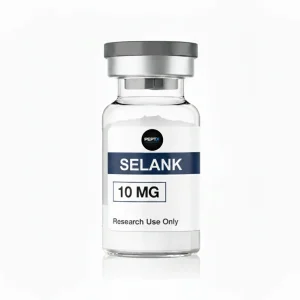
Semax is often examined together with other investigational neuropeptides, such as Selank, which also belong to the neuropeptide category. If you want a structured comparison of the molecules in this group and their research directions, the overview article Neuropeptides for research is worth reading. This context helps to understand how the structure of Semax and the models it is studied in differ from related compounds.
Closing note
Semax is an interesting example of how a small structural change – the addition of a stabilising Pro-Gly-Pro tripeptide – turns a fragile natural hormone fragment into a more durable subject for laboratory research. It is because of the in vitro observations on the BDNF/TrkB system that it remains a relevant part of the neuropeptide scientific literature.
For scientific research only. This article is informational in nature and is intended for the laboratory and in vitro research context. Semax is presented exclusively as a research material intended for use in scientific and laboratory experiments. It is not a medicine, dietary supplement or cosmetic product and is not intended to diagnose, treat, alleviate or prevent any condition in humans or animals. The article contains no dosing, usage or health recommendations. The material may be handled only by qualified professionals, in compliance with applicable law and laboratory safety requirements.
Frequently asked questions
Which in vitro mechanisms and models do scientists observe when studying Semax?
In the scientific literature, Semax is most often examined for its link with the neurotrophin BDNF and its receptor TrkB – in cell cultures and animal tissue models this system is a classic target of research on neuronal survival and synaptic plasticity. In a 2006 paper by Dolotov and colleagues (Brain Research), increased BDNF protein levels, increased TrkB tyrosine phosphorylation and a corresponding mRNA level were recorded in a rat hippocampal model. Laboratory descriptions also link the MAPK/ERK, PI3K/Akt and PLCγ pathways to this signalling axis. All these data are observations from in vitro and animal models and are not directly transferable to human physiology.
How should Semax be handled and stored in the laboratory?
Because Semax is a short peptide chain, the reliability of research depends on the purity of the material and correct storage. Peptide identity and purity are usually assessed chromatographically (HPLC). The lyophilisate is sensitive to moisture and temperature, so the powdered peptide must be kept under suitable conditions. The prepared solution is kept separately from the unopened lyophilisate, avoiding repeated warming and cooling cycles that could affect the reproducibility of results. These steps help ensure that the changes observed in an experiment reflect the properties of the molecule itself rather than degradation of the material or impurities.
How does the structure of Semax differ from natural ACTH, and why does it have no hormonal activity?
Semax is a synthetic heptapeptide with the amino acid sequence Met-Glu-His-Phe-Pro-Gly-Pro. The molecule is a hybrid: the N-terminal fragment (Met-Glu-His-Phe) corresponds to the ACTH(4-7) segment and is regarded as the informational part, while the C-terminal tripeptide (Pro-Gly-Pro) is an artificially added stabilising suffix that gives greater resistance to enzymatic degradation. Because only the short ACTH(4-7) segment is retained rather than the whole hormone chain, Semax lacks the steroidogenic (corticotropic) activity typical of natural ACTH, which is why the literature examines it as a neurotropic rather than an endocrine compound. In a similar way, it is studied together with other neuropeptides, such as Selank.
Are these materials intended for human use?
No. Semax is presented exclusively as a research material intended only for scientific and laboratory in vitro experiments. It is not a medicine, dietary supplement or cosmetic product and is not intended to diagnose, treat, alleviate or prevent any condition in humans or animals. No dosing, usage or health recommendations are given. The material may be handled only by qualified professionals, in compliance with applicable law and laboratory safety requirements.